Trending

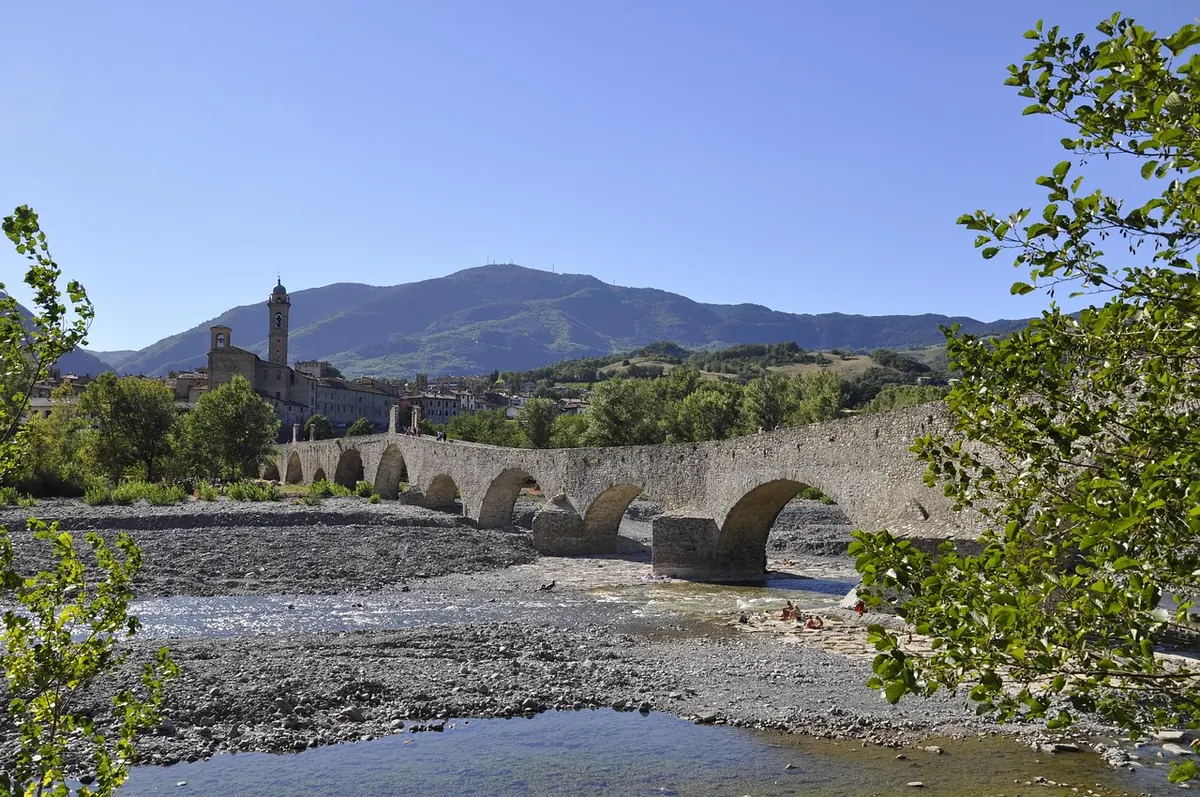
Almost every Italian town with a river has a bridge, and a surprising number of those bridges still have a Roman core under centuries of repairs. You do not need a permit, a trowel or a degree in archaeology to see it. You need a path down to the water, twenty minutes, and a rough idea of what Roman builders did differently from everyone who came after them.
What follows is a walker's method: where to stand, what to examine first, and which details usually settle the question. It will not date a bridge precisely — that takes documents and often a stone-by-stone survey — but it will help you tell a genuine Roman survivor from a medieval bridge built out of Roman rubble, or a nineteenth-century reconstruction dressed up as ancient.
The parapet is the least trustworthy part of any bridge. Parapets get knocked down by floods, widened for carts, replaced in the 1930s, and patched after every war. The evidence sits at the bottom, in the courses that were too expensive to move.
Find the riverside path — most towns have one, often on the downstream side where the bank is lower — and look at the bridge from the side, roughly level with the water. Concentrate on the first two or three metres above the normal waterline. That is where you see the original pier bases, the springing of the arches, and any Roman concrete that has lost its facing.
Bring a torch even in daylight. Under-arch surfaces are dark, and the shadows hide exactly the joints you are trying to read.
Arch shape is the quickest clue. Roman bridge arches are usually semicircular: the curve is half a circle, so the rise from the springing to the crown equals half the span. Stand back and eyeball it. If the height of the opening looks about half its width, the proportions are Roman.
A shallow segmental arch — a curve that looks like a slice cut from a much larger circle — usually points to later work, though Roman engineers did use flatter arches where a site demanded it, so treat this as a strong hint rather than proof.
The stones forming the curve are the voussoirs, and they are remarkably informative. Roman examples tend to be large, wedge-shaped, evenly sized, and set with thin joints. The ring is often framed by a projecting cornice or a second ring of stones, giving the arch face a slight step.
If the arch ring is made of small, irregular bricks, or of mixed stone bedded in thick mortar, you are probably looking at a medieval or later rebuild. If the voussoirs are wedge-shaped but obviously mismatched — different sizes, weathered faces, a fragment of carved moulding turned sideways — the design may be Roman while the arch itself was reassembled later from the ruins.
Where the curve meets the pier, Roman bridges often show a distinct horizontal course, an impost or springing course, that spreads the load. A crisp, continuous course at that level, in the same stone as the piers, is a good sign. A messy transition with brick修补 and rubble infill is a good sign of repair.
Materials are local, so learn the palette of the region you are walking in. A few broad categories cover most of what you will see:
Then look at the joints. Roman ashlar was frequently laid without mortar, or with a lime mortar so thin that a knife blade will not enter. Blocks were sometimes held by iron clamps set in lead; when the clamps were robbed out in later centuries, they left distinctive square or dovetail cuttings, and often a staining of rust or lead. Square holes in the face of a block may be lifting holes from the original construction. Small details like these are worth more than any plaque.
Piers carry the story. Roman piers are usually thick, broad at the base, and protected on the upstream side by a cutwater — a triangular or rounded projection that splits the current and limits scour. Downstream, the pier is often left square. Roman cutwaters tend to be low and blunt; sharper, taller cutwaters usually belong to later medieval work, when piers were added or rebuilt.
At each end, the bridge meets the bank in a massive abutment, sometimes stepping down in stages. If a Roman-looking abutment supports a much later arch, the bridge was rebuilt in place — the commonest story of all.
Watch too for exposed Roman concrete, opus caementicium. It looks like a rough grey-brown mass of rubble, lime and occasional brick or pottery fragments, and it survives where the neat stone facing has been stripped away by water. A concrete core between ashlar piers is a strong sign of Roman origin.
Almost no Italian bridge is purely Roman. Look for the horizontal seam where one phase ends and another begins: below it large ashlar blocks, above it brick or small rubble; below it a curve of one radius, above it a flatter one. Widening shows up from underneath as a vertical seam, with the upstream face original and the downstream face added.
Flood repairs appear as patches of different stone around the piers, sometimes accompanied by a carved coat of arms or a short inscription. Read those plaques as evidence of repair, not of origin.
If a bridge names a pope, a podestà or an engineer, it is telling you who paid to fix it, not who built it.
Rivers move. A bridge that now stands high above a shrunken stream, or whose arches land on dry ground, tells you the channel has shifted. Look for an older channel, a road that runs straight at the river and then jogs inland, or a town gate set well back from the water.
Street names give a lot away: Via del Ponte, Ponte Rotto, Ponte Vecchio. So does the road itself. A Roman road runs straight and meets its bridge on axis. Compare the bridge's axis with the modern street grid — a bridge sitting at a slight angle to later streets usually means the town grew up after the bridge was built.
Then go to the town museum or the local library and look for a plan of the river before the nineteenth century. Old maps and a few photographs will confirm or overturn everything you thought you saw. That is the pleasure of it: a bridge read carefully on a Sunday morning is a small piece of research, and the town archive is usually happy to help you finish it.
Photo: nonmisvegliate / Pixabay