Trending

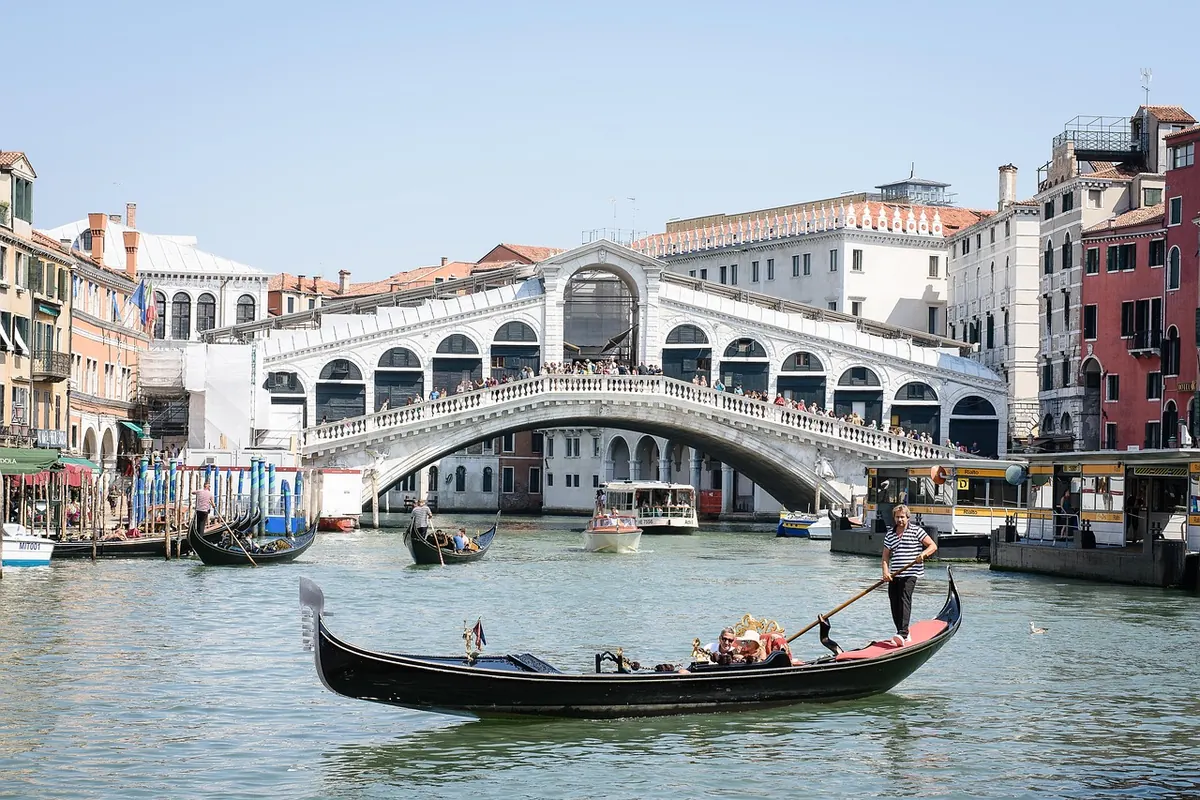
The 7.15 vaporetto from Ferrovia drops you at San Marcuola and the Cannaregio canal is doing almost nothing: no gondola traffic, no queue of tour groups, just a strip of grey-green water and the Ponte dei Tre Archi standing in it. It is January. Your hands are cold. Nothing is crowded.
Venice between December and February is not the city of the postcards. It is a working city with half its shutters closed, and its bridges — more than four hundred, depending on how you count — become usable viewpoints again. The trade-off is weather, tides, and a place that can feel shut in by four in the afternoon. Plan around that and winter becomes the best season for anyone who actually wants to look at bridges rather than photograph them over someone's shoulder.
From late November to February the sun never climbs high in Venice. It rises around a quarter to eight in late December and sets before half past four, and in between it tracks low across the southern sky, raking light down the canals instead of dropping it flat on the rooftops. Three things follow.
Facades get their colour back. The Istrian stone of the Ponte dell'Accademia shifts from white to warm cream by mid-afternoon, and the brick of the Tre Archi goes a deep rust red in a way it never does in June.
Shadows turn graphic. A single figure crossing a small ponte in Castello can throw a shadow the full width of the canal, which is why photographers put up with numb fingers in January.
Direction starts to matter more than time of day. Most of the smaller rii run roughly east–west, so the morning sun lights one bank and the afternoon sun the other. Walk into the light before lunch, away from it afterwards, and you spend the day looking at lit stone rather than silhouettes. The one real hazard is temperature: shaded steps that stay below freezing hold frost and thin ice long after sunrise, and wet stone in a north-facing calle is genuinely slippery. Take the handrail.
Acqua alta keeps a lot of people away in winter, and it is worth understanding before you book, because it is not a storm. It is a tide: a combination of the lunar cycle, low atmospheric pressure and a sirocco pushing water up the Adriatic. It arrives on a schedule, peaks, sits for a few hours and drains away. Forecasts are reliable two or three days out and revised daily.
The MOSE barriers at the lagoon inlets now hold back the highest predicted tides, so the knee-deep Piazza San Marco events of a decade ago are rarer. They do not stop every high tide, though, and moderate water still slicks the lowest campos and the Zattere. Learn the shape of the city: the lowest ground is around Piazza San Marco, the Zattere, and parts of the northern fondamenta. Raised walkways — passerelle — appear along the main routes, and they are slow and crowded; the quiet parallel calle may have no walkway at all and ankle-deep water.
This is where bridges earn their keep. The arch is the highest point on any flooded route, so a bridge is dry when its approaches are not. Plan errands bridge to bridge and you will stay out of the worst of it.
The Rialto and the Bridge of Sighs are worth seeing once, at eight in the morning, and then worth avoiding. These five reward the cold walk:
Cannaregio, north side. Start at San Marcuola, follow the Fondamenta de la Misericordia, cut inland to Ponte Chiodo, then out along the canal to the Tre Archi and on to San Giobbe. Ninety minutes at a stroll, and the only traffic is people carrying shopping home.
Dorsoduro, west end. Campo San Barnaba, the Ponte dei Pugni, the little bridge by the Squero di San Trovaso where they still build gondolas, then the Zattere. The Zattere floods first and dries last, but on a clear cold afternoon the light on the Giudecca across the water is the best free view in the city.
Castello, east. Be at San Marco by eight, when the square is empty and the water is still, then head north through Campo Santa Maria Formosa and keep going to Sant'Elena. Bridges thin out, the lagoon opens up, and the last stretch of waterfront has benches facing the water.
A Venetian bridge is a road, not a terrace. It is usually one and a half people wide at the top, it carries two-way foot traffic, and someone behind you is trying to get to work. The etiquette is simple and almost entirely about not being the obstacle.
Pull to the side before you stop. Never stand in a group across the apex. Do not sit on the steps: many bridges carry a local ordinance against stopping or sitting there, fines are enforced, and the steps are the walking surface for everyone else. Keep your voice down in residential sestieri early and late — sound carries over water in a way it does not on a street. If you are photographing, take the shot and step down; a tripod set across the Accademia bridge at sunset is a genuine obstruction. And do not point a lens into ground-floor windows.
Cold hands end more winter walks than rain does. Build in stops: a coffee at the counter, standing up, takes four minutes and costs less than a seat. Church naves are colder than the street, so save the Frari and the Salute for the middle of the day, when the sun has had a chance to work on the stone. The museums — Correr, Ca' Rezzonico, the Accademia galleries — are warm, dry, and best visited when the tide is high anyway.
Photo: mfoddo / Pixabay